Twenty Forward > Cathy Lee

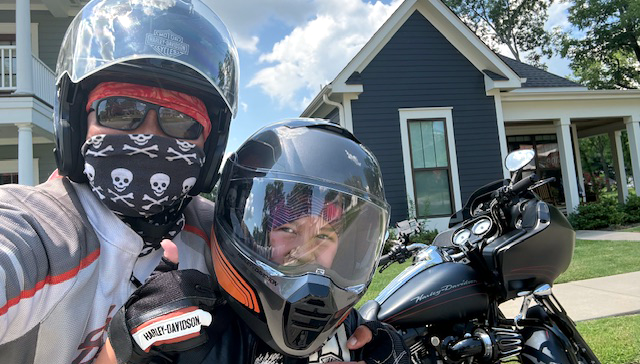
A woman and a child taking a selfie on a motorcycle in front of some houses. Both are smiling and wearing helmets.

The 2025-2026 CenterPoint Scholars focused on Communication and Connection. They contracted with Kate Elliott, associate lecturer of journalism at Ball State, to conduct a series of $20 interviews called “Twenty Forward.” Each month, Kate puts $20 in the hands of two Muncie residents and then writes about who or what they support with their modest but meaningful investment in our city. Read the project introduction to learn more.


After tragedy, she chose a life without limits

By Kate H. Elliott

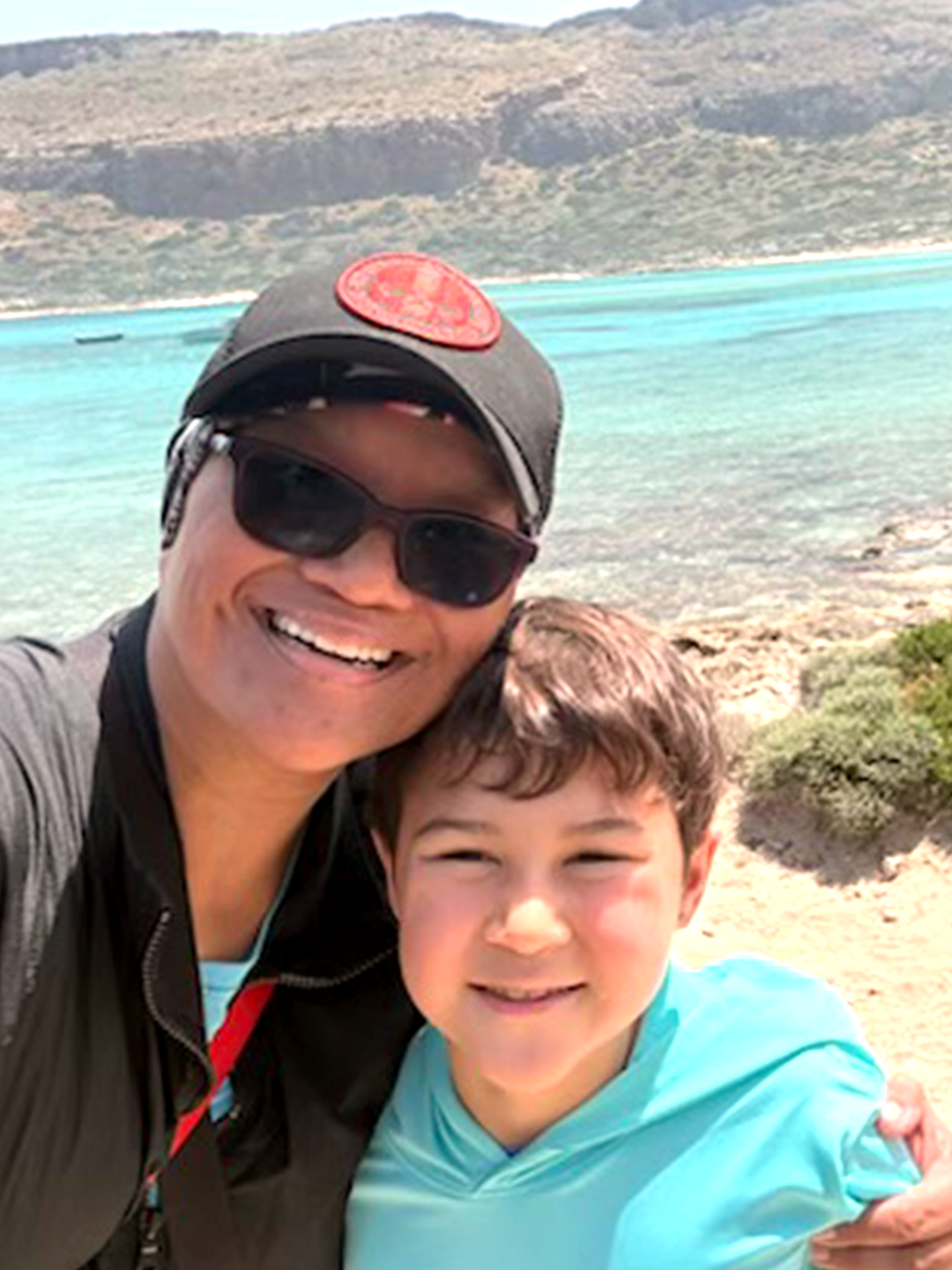
A smiling woman and child taking a selfie against a beautiful beach backdrop

Her younger brother played on the deck while 10-year-old Cathy Lee Arcuino splashed in their backyard pool. “Watch your brother,” her mom said, and she did — until she pulled his limp, 2-year-old body from beneath the surface.

For the next 16 years, Cathy Lee helped her parents clean Rey John’s trach, flush his G-tube and more for eight hours a day before handing off his care to a privately paid nurse for the remaining 16.

“I knew he would never wake up, but I think my mother always held out hope,” Cathy Lee said. “I will never know, though. My parents immigrated to the United States from the Philippines, and in our culture, you don’t talk about it. It was all around us, but we never talked about it.”

When she graduated high school, Cathy Lee desperately wanted to leave Fresno (California). She felt trapped — every day at home was a reminder that Rey John drowned on her watch. She did move a few hours away for college but drove six hours every weekend to return to Rey John. One day, she sat beside him and made a pact: “’Please let me go into the Peace Corps,’ I asked him. ‘Then I will come back and fulfil my duty to watch you.’ I don’t know that he heard me, but I felt a peace about going, so I did.”

Cathy Lee boarded a plane for Kazakhstan to live in a remote village, where she “pooped in a hole and wiped my ass with the pages of a Russian book that you’d throw into a basket to burn later for heat.”

A year and a half into her service, Cathy Lee learned that Rey John died.

“It rocked my world,” she said. “But I began to wonder if it was almost a gift to me because he knew I wanted to get out and live — for me and for him. I made a pledge to never live in a coma, to walk around mindlessly like so many people do. I wanted to do something with my life, so I live big and in my own way, bringing Rey John with me everywhere I go. He’s my guardian angel.”

Since then, Cathy Lee has traveled to more than 50 countries, worked for a nonprofit in Kyrgyzstan and taught English in Poland, Thailand and Japan. She rides her Harley across the country, wears clothes with skulls, jewels or both, and collects tattoos that tell the story of her life.

By 35, Cathy Lee had earned a Ph.D. in educational leadership. The following year, she decided she wanted to have a daughter: “I didn’t want a relationship, so I asked my gay best friend, David, to donate his sperm.” A year later, Mirasol, was born.

“Her name means ‘Sun-watcher and sunflower,’ and my nickname for David was ‘Sunflower’ since we met in the Sunflower State (Kansas),” Cathy Lee said. “Mirasol is bright like a sunflower, so her name fits her.”

Mirasol makes her mother proud: “She’s 10 and rocks a pixie cut, has traveled with me to 23 countries, and, in January, won the Martin Luther King Jr. Award for exemplifying the qualities of MLK Jr.”

The two have moved to four states as Cathy Lee has built a career in international education, eventually landing at Ball State University as executive director of Graduate & International Admissions and Services.

“I oversee Ball State’s graduate and international admissions and supports international students before, during and after enrollment,” she explained. “I love and live for working with students — both helping international students adjust to life and learning in the United States and helping American students explore overseas.”

Cathy Lee will invest her $20 in Ball State’s Rinker Center for Global Affairs to support students studying abroad. Pushing out of one’s comfort zone is Cathy Lee’s greatest advice to students: “It might be community service in your town, a mission trip to a Native American reservation or a study abroad experience. These all provide you with opportunities to get outside yourself, which enriches your life in unimaginable ways.”

The more different the experience is from your life, the better, she said. “Go to a country that speaks another language or go poop in that hole,” she said. “Those experiences test you, stretch you and often make you more grateful and resilient and interesting.”

Then, she tells students to make a difference — not necessarily in a big way but in some way. “Sometimes the small things are the big things,” she said, “Don’t minimize showing up for people or helping neighbors and loved ones. We can all do good and be good.”

And when others aren’t good to you, lead with questions, she advises, after a lifetime of people assuming she can’t speak English or is not from America. At a Kansas grocery store, a woman asked her, ‘Where is the rice you all cook in China, and how do you cook it?”

“I have learned to respond with questions or a story so people can better understand my experience or stance,” she said. “I’ve found that approach leads to more empathy and understanding.”

Cathy Lee gathers stories through travel and connections with others. “This is why I love my job,” she said. “Every day, I get to talk with students, hear their stories, and empower them and provide support. I get to watch them dream and go and grow.

Those meaningful connections are Cathy Lee’s way of “doing good” in the world. “I wasn’t able to make a connection with my brother, so I make connections with others and the world. That passion for life and people helps me make meaning of tragedy.”


Thank you to Muncie Action Plan and CenterPoint Scholars for supporting these small but meaningful investments in community. Go to Twenty Forward to read this and other stories about what your neighbors are doing with $20.

Twenty Forward > Tracina Greenleaf

twenty forward header image

The 2025-2026 CenterPoint Scholars focused on Communication and Connection. They contracted with Kate Elliott, associate lecturer of journalism at Ball State, to conduct a series of $20 interviews called “Twenty Forward.” Each month, Kate puts $20 in the hands of two Muncie residents and then writes about who or what they support with their modest but meaningful investment in our city. Read the project introduction to learn more.


‘They never had the boots’: Trae Greenleaf champions dignity, housing and hope for Central Indiana families

By Kate H. Elliott

A black and white headshot of Trae Greenleaf, a black woman with a slight smile in a white blouse complimented by black jewelry.

Tracina Greenleaf introduces herself like this:

“My name is Tracina, but people call me ‘Trae,’ which stands for Transition, Reform, Advocate and Educate. That’s my name, and it’s what I stand for.”

As operations manager for the YWCA Central Indiana, Trae spoke with Ball State students about the organization’s work to eliminate racism, empower women, promote social justice and help families in the seven counties it serves.
“Our residents are your friends, your grandmother. They are me and you, and they — like all of us — deserve respect and dignity,” she said.

Trae gave an example. She often does — because in her line of work, examples remind people of their shared humanity. She’s not talking about abstract concepts like “poverty,” “assault” or “hunger.” She is talking about people.

“We recently had some high school students stay with us — a set of twins at Muncie Central and a young woman at Delta. You would have never known they were unhoused,” she said. “They were popular, engaging — the whole nine yards. We helped them go to prom and had graduation parties for them here at the YWCA. We told them, ‘You don’t need to tell people you are staying upstairs, just that you rented a room here for the party.’”

Trae got teary, and so did the students.

“One of those kids is now in nursing school and working for a congress person,” she added. “She’s doing really well — one of our success stories.”

More than 40% of those served at the YWCA Central Indiana are between the ages of 0 and 17, according to the organization.

Trae and her staff do “anything and everything” for more success stories among the roughly 600 people they serve each year. The YWCA partners with Ball State, Ivy Tech, Meridian Health Services and more to provide mental and social support to those in need. They provide education about financial literacy, housing, healthcare and professional development. They also meet basic needs for clothing, food and daily essentials.

“We are the only residential stay program for women in seven counties, and we are the state’s only YWCA that accepts mothers with sons over age 10 into its emergency shelter and temporary stay programs,” she said. “We are committed to keeping families together.”
Trae and Executive Director, WaTasha Barnes Griffin, fill their calendars speaking to clubs, churches and schools to advocate for the organization’s mission and to spread awareness about needs in the region. They join their staff at informational tables and benefit walks. They stock shelves, help women budget, and read bedtime stories to the YWCA’s youngest residents.

“We will stop when the work is done,” Trae said, “and the work will never be ‘done.’”
Learn more about the YWCA Central Indiana at ywcacentralindiana.org. The site includes a donation list, information about upcoming events and ways to get involved.
Not everyone has the same opportunities or access, she told the students. “So, when people say or think our residents should just ‘pull themselves up by their bootstraps,’ I say, ‘They never had the boots, let alone the straps.’”

Trae cares about all the nonprofit’s priorities, but she is especially focused on affordable housing. For every 100 extremely low-income renters in Indiana, only 38 affordable and available housing options exist, according to Prosperity Indiana and the National Low Income Housing Coalition. Nationally, more than a third of extremely low-income renters work, another third are seniors, and many have a disability or are students and caregivers.

“People who struggle to pay rent also tend to have trouble paying for other basic necessities — often sacrificing things like food, healthcare or childcare to have place to live,” Trae said. “And then, a car accident or unexpected medical bill prevents them from going to work, and then they are out on the street or bouncing from couch to couch. A warm home is the foundation for a stable life.”

A student raised her hand: “What can we do?”

Trae didn’t hesitate: “Vote.”

“I won’t tell you who or what to vote for, but I will tell you to vote based on the interests of your family and your community,” she added. “Yes, of course, you can volunteer and donate and spread awareness, but you — we all — have the greatest impact with our vote to set the priorities for our government.”

Trae is giving her $20 donation to support the YWCA, but what can $20?

“More than you think,” Trae said. “Every donation — just like every bottle of shampoo — helps. Everyone can make a difference in their own way. Too many people don’t give of their time, talents or money because they don’t think it’s enough. It is.”

Learn more about the YWCA Central Indiana at ywcacentralindiana.org or check them out on Facebook and Instagram.

Thank you to Muncie Action Plan and CenterPoint Scholars for supporting these small but meaningful investments in community. Go to Twenty Forward to read this and other stories about what your neighbors are doing with $20.
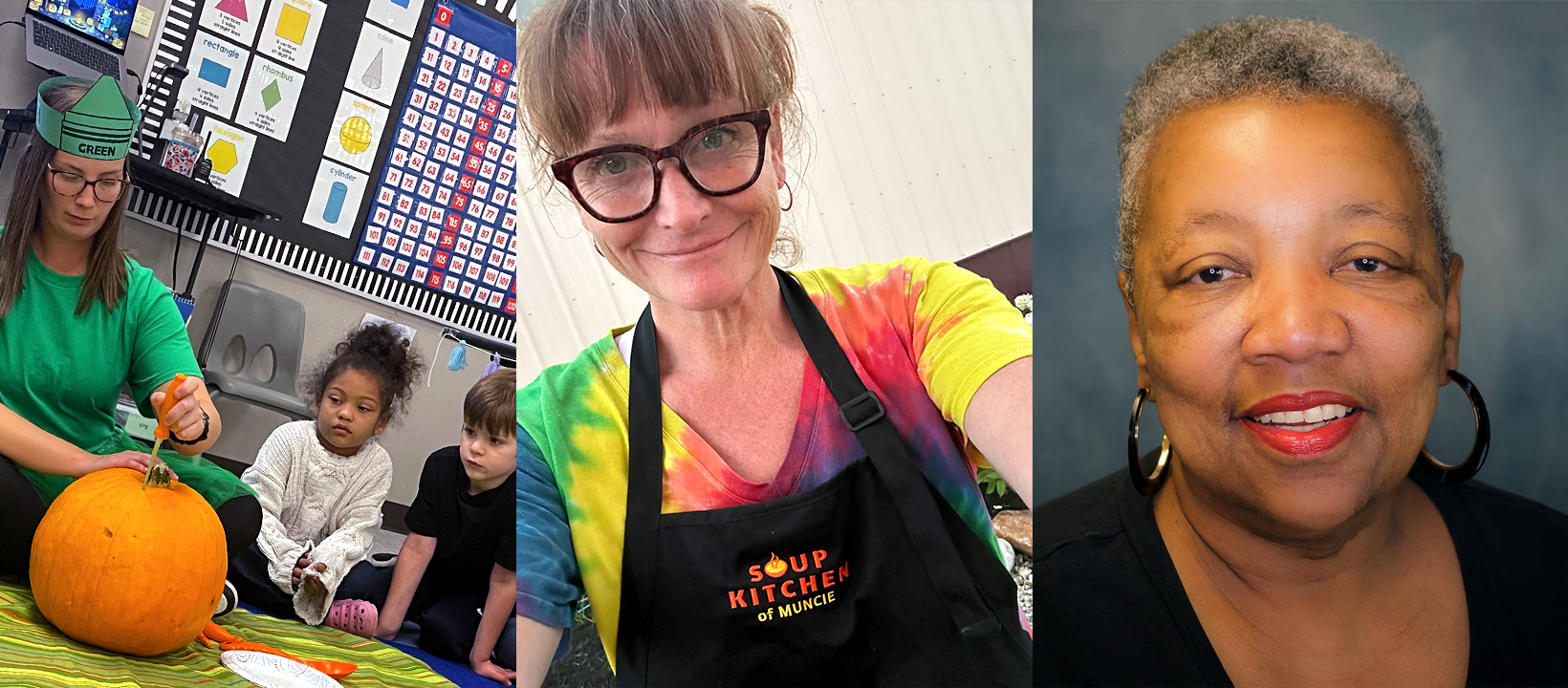
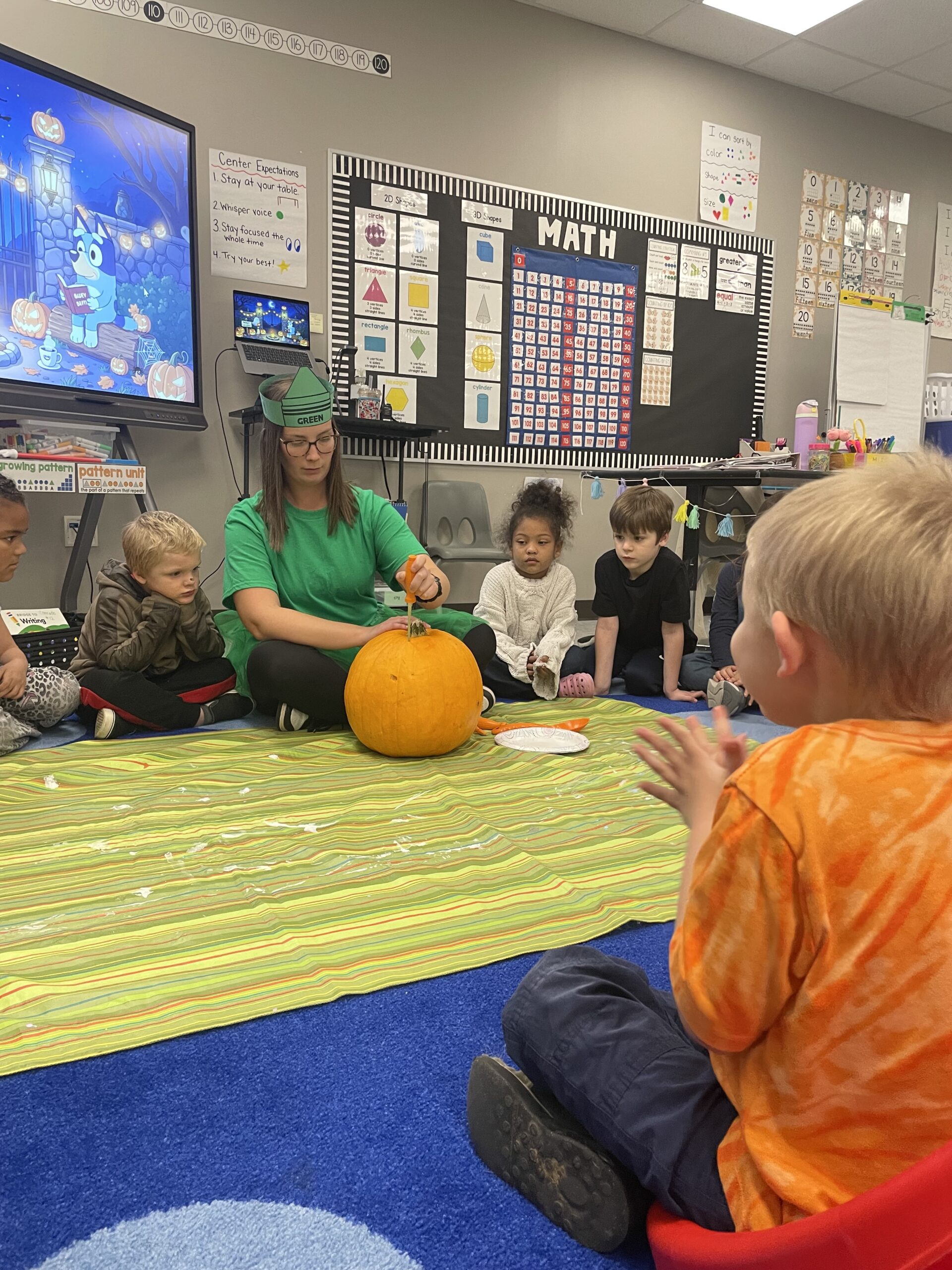
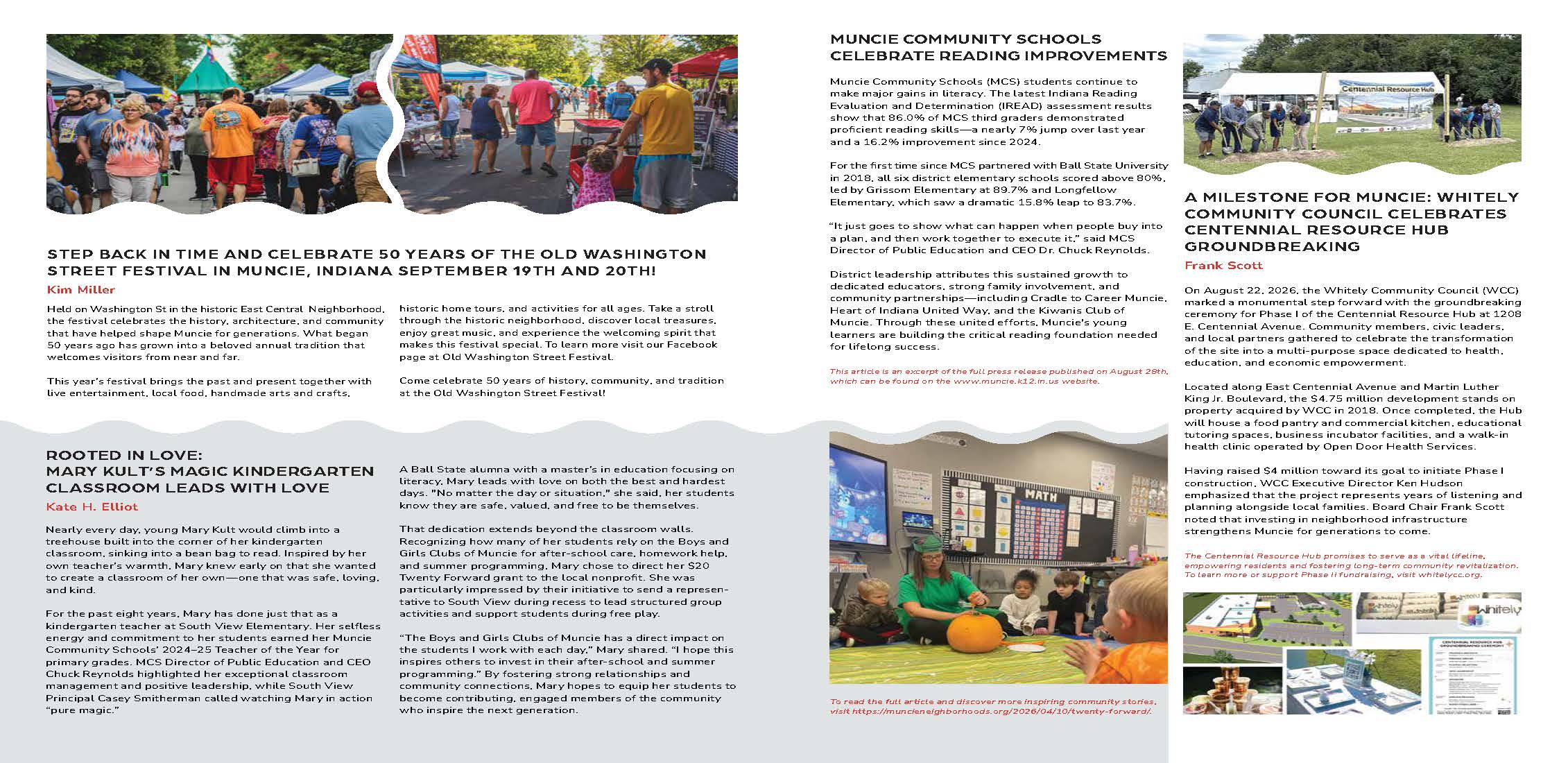
Mary Kult sits on a colorful floor surrounded by attentive children who watch her carve a pumpkin

Mary Kult

Rooted in love

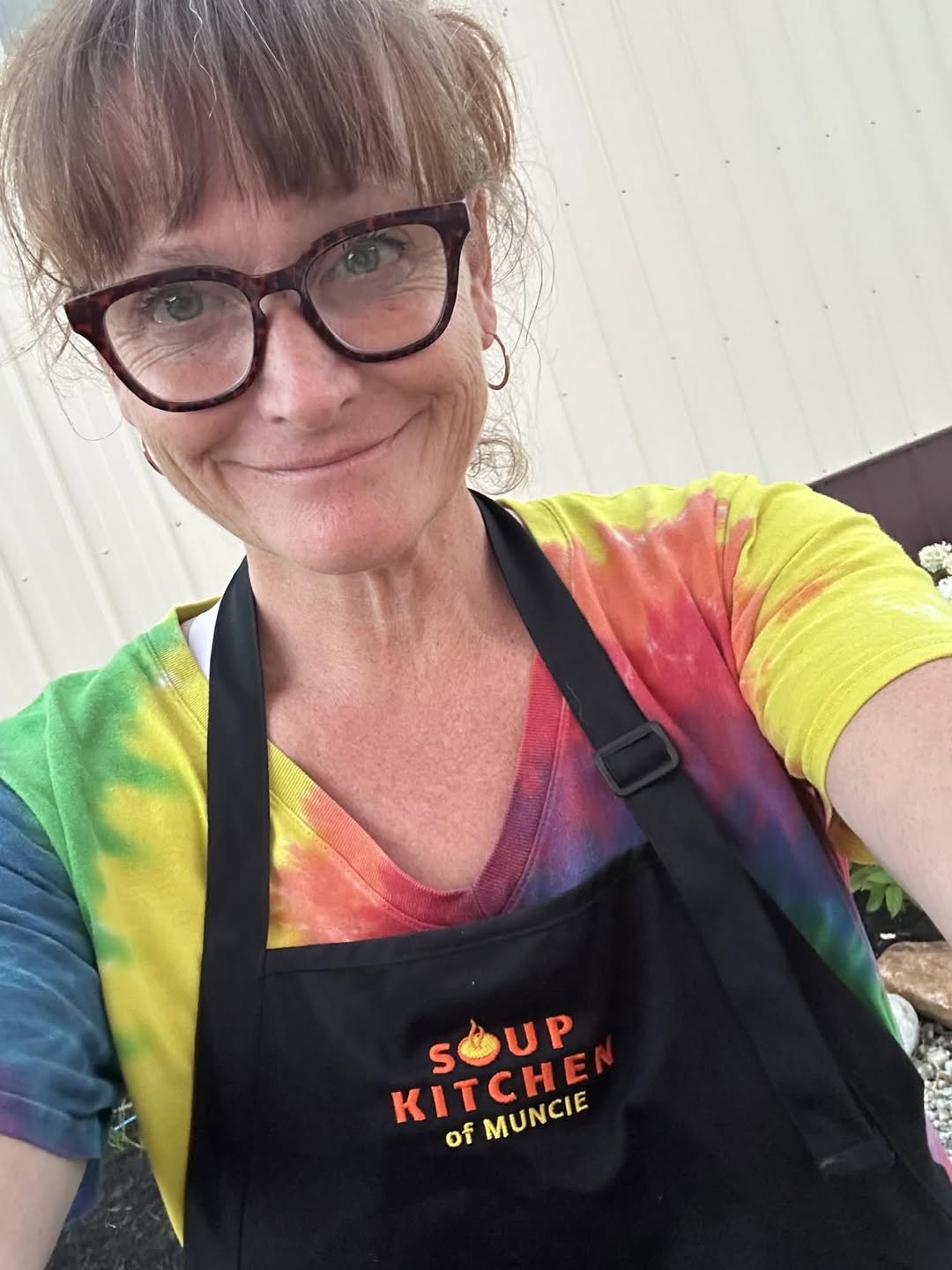
Christiana Mann selfie - she is wearing a rainbow tie dye shirt under a black apron with a "Soup Kitchen of Muncie" logo on it.

Christiana Mann

Hospitality with heart

CenterPoint Scholars initiates printed neighborhood newsletters

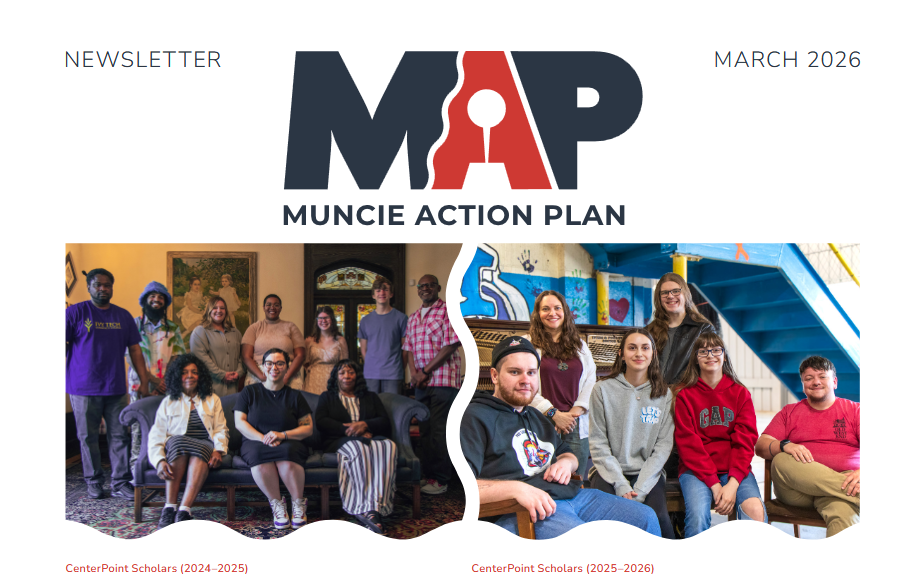
Screenshot of the header of the March 2026 CenterPoint Scholars MAP newsletter. The date is at the top along with the MAP logo and the CenterPoint Scholars class of 24-25 is on the left beneath it, with the class of 25-26 on the right.

Our CenterPoint Scholars (2025-2026) launched printed neighborhood newsletters at the IDEA Conference in March of 2026. These newsletters will be released every few months and are being designed by the excellent students of Ball State University’s Studio 165+. Check back often for new issues.

Read the latest newsletter:

DOWNLOAD (pdf)


Read this year’s newsletters:

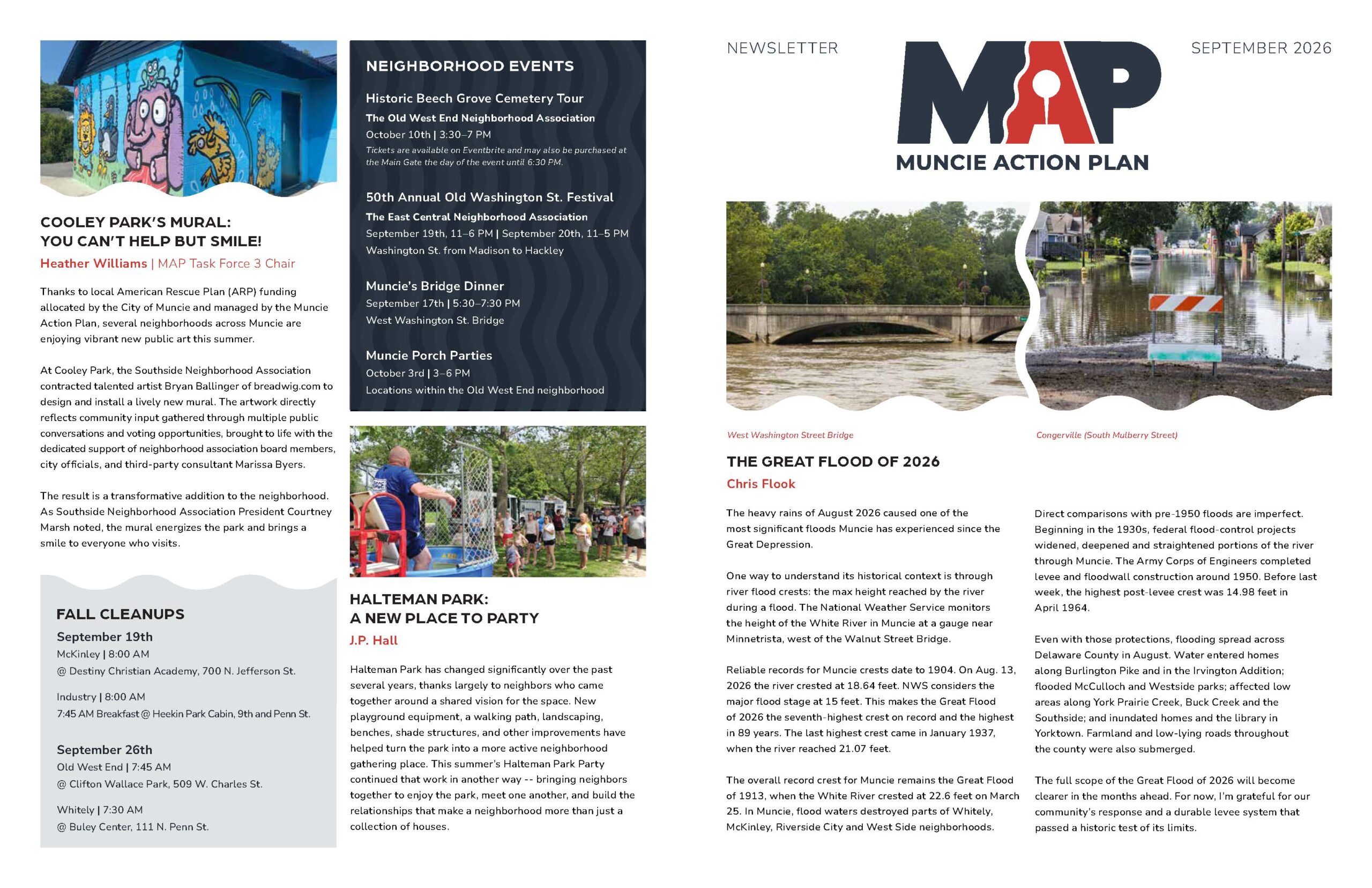
MARCH 2026 | Download (pdf): containing articles on the CenterPoint Scholars, Laundry Love, the 5:50 Alliance Food Fridge, Twenty Forward, and the Helping House as well as information about Neighborhood Spring events and Muncie Waypoint.
JUNE 2026 | Download (pdf) – containing articles about the 2026 IDEA Conference, South Central, Porthlight Radio, Porch Parties, and more.

Muncie Waypoint: A guide for greater community and neighborhood engagement

Article by Charles Taylor

Do you care about Muncie but feel overwhelmed by where to start or how to make a difference? Muncie Waypoint turns local engagement into a tangible, rewarding challenge helping you shift from passive news consumption to active leadership by shaping issues that matter, such as the quality of your local neighborhood.

When you sign up for Muncie Waypoint, you’ll receive weekly email newsletters with information that will help you engage with local government or your neighborhood. Recent newsletters have covered issues like providing effective citizen input at a local government meeting or conducting a walk with your neighbors to identify neighborhood conditions that need attention.

You can take the next step by acting on what you learn. Muncie Waypoint provides a long and flexible list of activities for learning, building community, and influencing politics. When you take these actions and log them using our online form, you earn points for advancement, a prize, and an invitation to a year-end celebration.

You can learn more about Muncie Waypoint and sign up by visiting https://munciewaypoint.substack.com

Want to see who racked up the most points in April? View the leaderboard.

Porchlight Radio – new radio show lauched by CenterPoint Scholars

Our CenterPoint Scholars (2025-2026) just launched their Porchlight Radio show on WMUN. Episodes are available on WMUN’s Facebook page. Check back often for new episodes.

Listen to the latest episode:


List of Porchlight Radio Episodes

EPISODE 1 (4/6/2026): Porchlight Radio hosts Sam and Jasmine speak with guest Denise King to talk about community, connection, and her experiences on the Old West End. LINK

EPISODE 2 (5/3/2026): Porchlight Radio hosts Sam and Jasmine continue speaking with guest, Comedian, Actor, and Musician Tommy Davidson about his upcoming Muncie show, his past, and how it made him who he is today. SEGMENT 1 | SEGMENT 2

Twenty Forward > Yvonne Thompson

twenty forward header image

The 2025-2026 CenterPoint Scholars focused on Communication and Connection. They contracted with Kate Elliott, associate lecturer of journalism at Ball State, to conduct a series of $20 interviews called “Twenty Forward.” Each month, Kate puts $20 in the hands of two Muncie residents and then writes about who or what they support with their modest but meaningful investment in our city. Read the project introduction to learn more.


From Longfellow to leadership: Yvonne Thompson’s commitment to Muncie children

By Kate H. Elliott

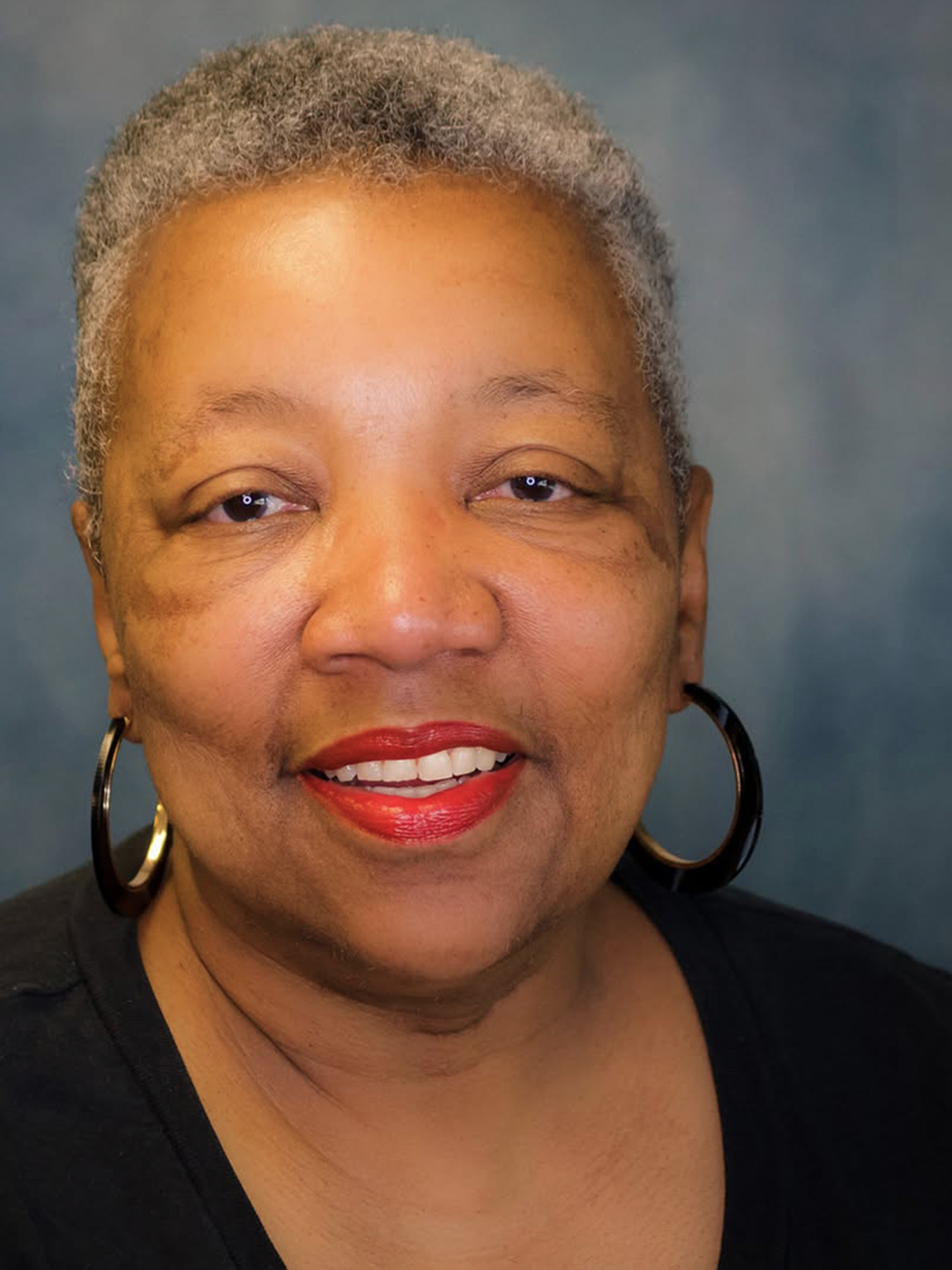
Headshot of Yvonne Thompson, a black woman with a bright smile wearing a black shirt and black and gold hoop earrings on a gray/blue background

Yvonne Thompson loved first grade. She’d wake to homemade biscuits and margarine before walking past her daddy’s service station to Longfellow Elementary. Mrs. Mary Dollison was there to greet Yvonne with a smile. “Mrs. Dollison cared for us deeply and made learning come to life,” Yvonne said. “She knew education was the key to our success, and she believed we were capable of greatness.”

Yvonne and others saw themselves in Dollison, who looked like them, went to church with some of them, and lived in their neighborhood. “Representation matters,” Yvonne said. “As a Black child in 1964, it was empowering to have a Black teacher.”

At the time, Longfellow and Garfield elementaries were the only two of Muncie’s 15 elementary schools that employed Black teachers, and Longfellow made history by hiring the city’s first Black teacher in 1952 and first Black administrator in 1956. Yvonne was proud to attend a school with those “milestones of progress,” she said.

Years later, when Yvonne returned to Muncie in 2005, she reconnected with Dollison, who had gone on to establish (alongside Rashana Shabazz) Motivate our Minds — a nonprofit that offers year-round academic achievement and enrichment programs for children and families. Her former teacher, now a driving force in the community, encouraged Yvonne to become executive director of MOMs.

“It was a wonderful opportunity to come full circle,” Yvonne said. “Ms. Mary had inspired me to dedicate myself to others, to invest in people the way she invested in me. Leading the organization she founded was a great opportunity to directly give back to the community that raised me.”

Yvonne led MOMs for two years through a time of tremendous growth, as the nonprofit expanded and diversified its after-school enrichment programs, summer camps and individualized instruction and support. “We made education so fun, those kids didn’t realize they were learning,” she said of MOMs, which supports the longest running Scouting America program in Delaware County. “We certainly covered the basics, like math and reading, but we also offered violin and choir, and we helped prepare kids to navigate the hits of life.”

Yvonne went on to serve the city as executive director of the Muncie Human Rights Commission for more than 17 years, but she remained involved with MOMs as a volunteer and now as president of its board of directors. The organization’s commitment to children is why Yvonne is giving her $20 to Motivate our Minds.

“Kids are our future,” she said. “I want my $20 investment to help sponsor a child because MOMs helps children become better citizens, not just in Muncie, but better citizens of the planet. Investing in our children strengthens our future.”

Yvonne, who retired from the city in 2025, said she hopes to inspire MOMs kids the way Dollison inspired her. “I want them to see me, a kid from Whitely, who has found success and made a difference in the world,” she said. “But I also want to connect with them and make them laugh, like the other day, when I told them I was 67. They had such a good time with that 6-7 thing. They went crazy.”

The mother of three is also board chair for Inspire Academy, a tuition-free public charter school serving pre-K–8 students in Muncie. Seeing graduates of the school and MOMs achieve success is what motivates Yvonne to keep serving.

“We are creating a culture — a community, really — of people who feel seen and valued and supported, and then they go on to see, value and support others in their personal and professional lives,” she said. “That is powerful. Life is hard, and there will be hits, but we help them have courage and gain inner strength to know who they are, to know what matters, and to know what to stand for. Seeing these kids grow up into their best selves is a great honor and reward.”

Learn more about Motivate our Minds at motivateourminds.org.
Thank you to Muncie Action Plan and CenterPoint Scholars for supporting these small but meaningful investments in community.

Mary Kult sits on a colorful floor surrounded by attentive children who watch her carve a pumpkin

Mary Kult

Rooted in love

Christiana Mann selfie - she is wearing a rainbow tie dye shirt under a black apron with a "Soup Kitchen of Muncie" logo on it.

Christiana Mann

Hospitality with heart